In May 2012, Rachel Harrison opened her show
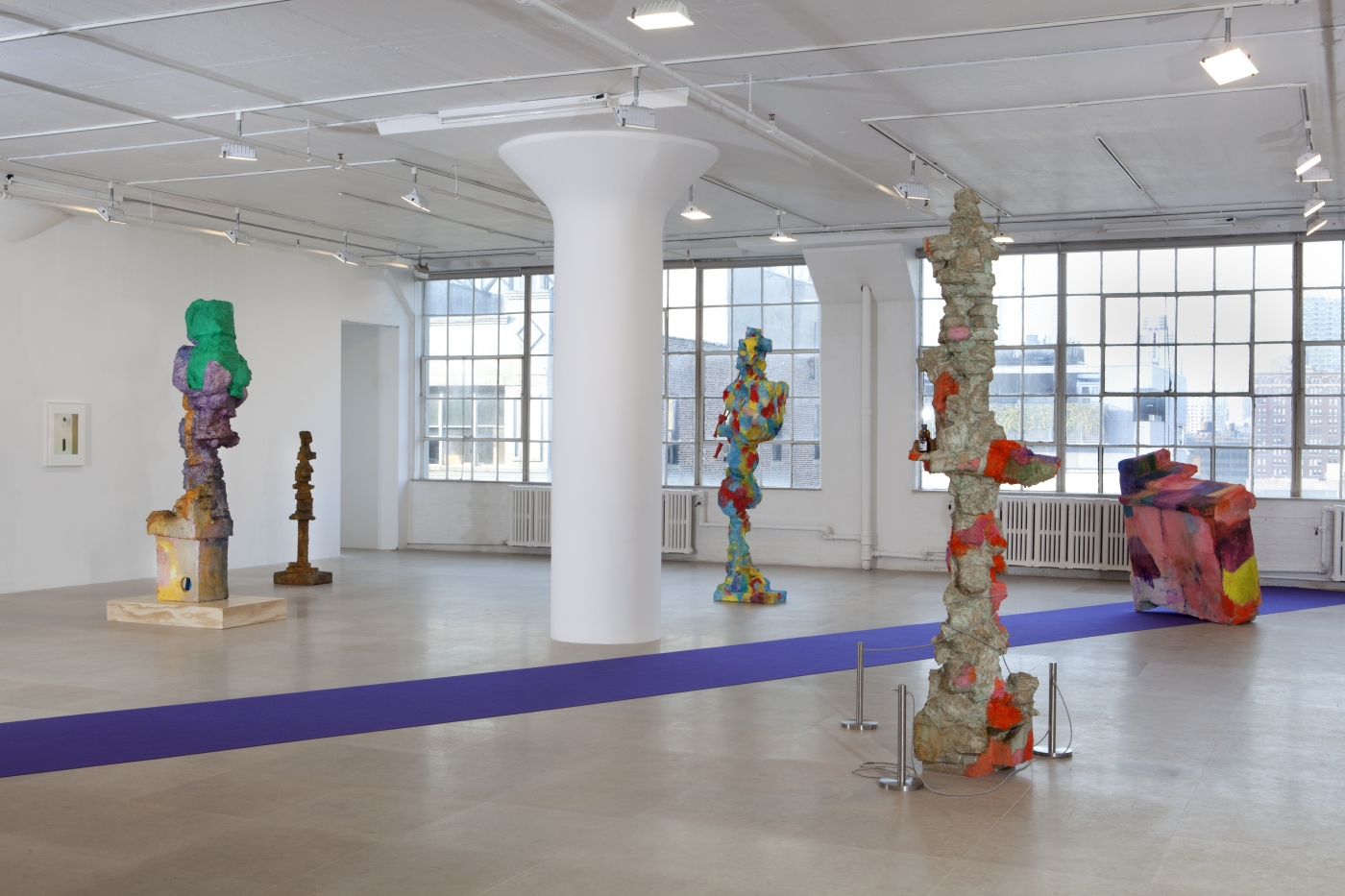
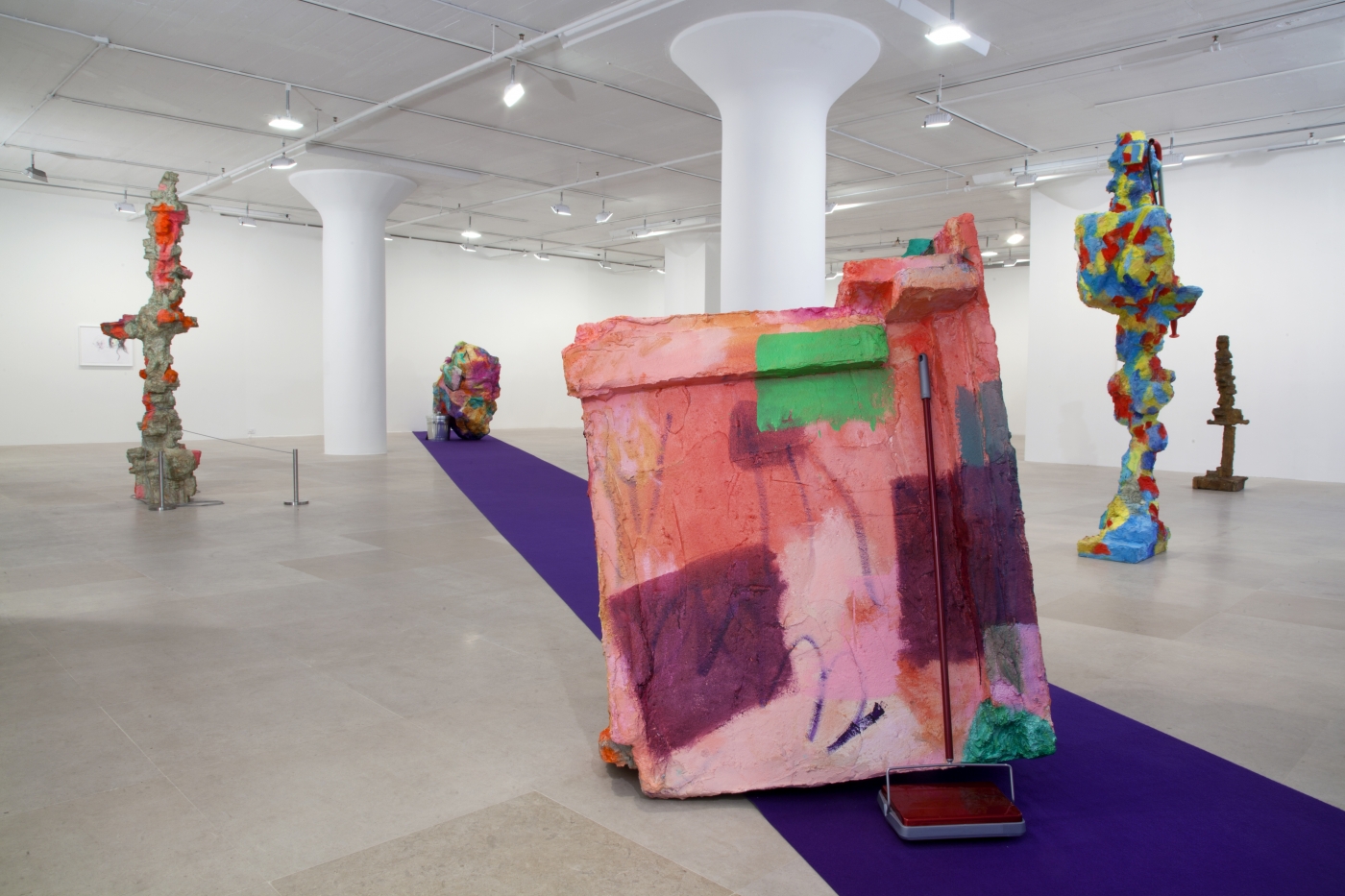
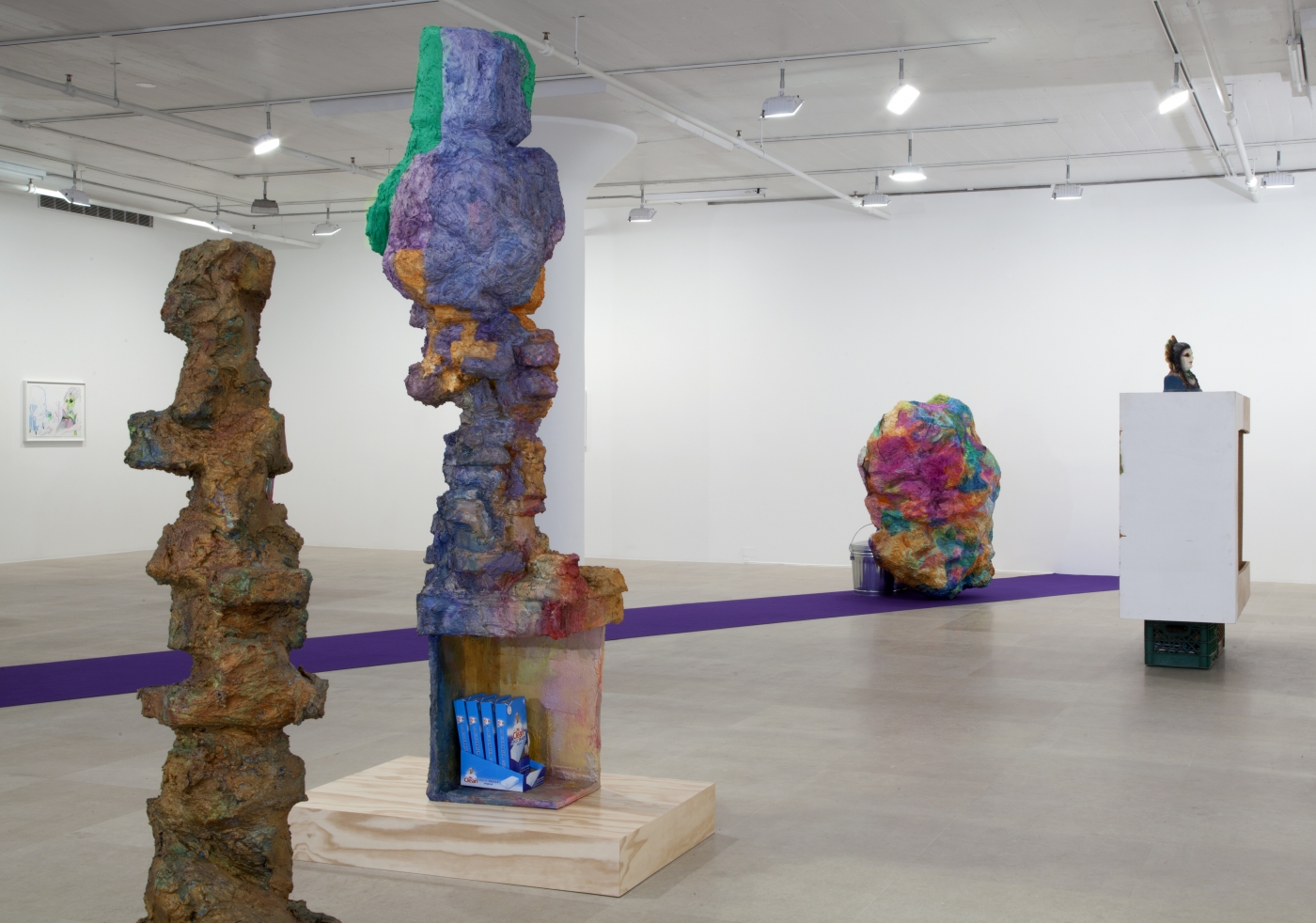
The Help at Greene Naftali gallery, New York. A long, purple carpet (like one down which Willy Wonka might walk, stretching to the gates of his chocolate factory) cuts through the middle of the room. An astroid of multicolored mush anchors one end of the rug as it sits stubbornly where it seems to have landed, half-atop a tin garbage can and a television looping a point-of-view film of a nighttime cab ride. The boulder does not look particularly comfortable, though immovable. The other end of the rug is held by a patchy green-and-pinky box like a cabinet-shaped paperweight. Behind its back it hides a carpet sweeper. Doing the rounds it seems, or paused. This must be the help. Working hard? Or hardly working? None respond, it does not turn, yet there hangs an eery sense of order in the air, as though each has done/does/is doing their duty, everything in its right place, all quiet and well. This in contrast to the gnarled silhouettes and paintball blasted skins of each of the lazily poised forms, each at once slouching and looming. Along with the collection of Amy Winehouse colored pencil drawings hung about the walls, twelve sculptures in total populate the room. Each is like a gracefully grotesquely lumberingly awkward cartoon. They mill about the space from their places like topiaries rooted in a garden. While one sweeps the rug, another, an ice-cream-column of yellow, purple, green lumping stuff piled atop a bare wood base shuffles off toward the corner, cradling a red, white, and blue package of Mr. Clean Magic Erasers in a shelf beneath its knees. Something must need doing. And across the purple carpet, toward the entrance, is a spindly pillar looking like a tree of stacked up stones set candid on the side of the road and sprayed with red paint, stuck, having tangled itself up in the cable and stainless steel pylons of museum security. "Please do not touch," I imagine it croaking as it constricts itself tighter, the color washing from its blank grey face, and it falls apart like Jenga. A garden of intricate topiaries where the gardeners are also the gardened, the topiaries. As if the ghost of Edward Scissorhands had inhabited his garden postmortem, artist made one with his creations, and the many faces of Amy Winehouse peering from the walls might be thought that damned spirit's reflection, the spirit of the artist backed into a dark corner and there enslaved to art where they can work and work and work like a madperson so that they tear themselves up and strain their eyes blind, their fingers arthritic, busy themselves in their dark little corner so that no one hears from them again, until they die. Intricate yet amorphous monoliths made of cheap materials and painted garishly childlike, with forms recalling rock formations, trees, flowers, and totem poles as much as melting ice cream cones, Futurist (Fascist) idols, deadly weapons, Cronenberg abominations, and piles of shit. The two opposing faces of so-called 'art,' dark and light. The readymade token that most of the forms bear like a brooch is what gives the statues a sense of ontological/metaphysical autonomy, ie. personal and individual subjectivity and agency. As if they were just other actors in our world. Simultaneously, the positioning of the brooches serves to dismantle the readymade objects first aesthetically, then conceptually. Thus as the motley monoliths step with one foot onto our plane, they also drag bits of our constructed world back behind them. Like physics, the equal and opposite reaction to their pulling themselves in toward our world, hefting at the threshold, struggling to hold balance. Mass must be displaced, a vacuum opened, in order for an entrant of (or entrance unto) new mass to be made visible. That is the new realities the figures usher in as they crack the shell of constructed perception in the individual. And displace, that is crack, they do, as their faces are abrasive and fluorescent, the looming presence of their mangled bodies impossible to ignore. And what are cracks but perversions of a surface? Thus do the statues appear as figures of old, overlooked, accepted, repressed, but certainly well known realities, chewed halfway up like a fistful of Skittles and spit back out. Harrison's sculptures are, in this way, anti-monuments. Not re-enforcing that which has been before enforced or come to pass, or that which has been remembered, but de-enforcing that which is accepted as brutally true, that which we never remember learning, and that which has always been known, known for so long that it was forgotten that it was known at all, until one is asked that it be truly forgotten, and so it is recalled. The truth of absurdity. The absurd truth. The absurd truth of the absurdity of truth. Poised like monuments, hailed like monuments, self-asserting and physical, that is speaking, like monuments, yet empty, hollow. Made of not marble or bronze but concrete and styrofoam. Bubbling phalluses painted like a kindergarten art room, vibrant and harsh like the colors of the ancient Greek marbles before they were scrubbed clean by the Renaissance-men, Enlightened folk, and Neoclassicists who admired them so (though only when so bleached). Harrison's statues are as great, as tragic, as hilarious, as horrible, as timeless, as infinite. They disrupt the Euro-phalli-centric tradition as much as they accept its narrative, for it is inevitably the frame in which all fine Western art today will be viewed. They are very plainly everything that they are, like the Washington Monument. But more significantly, more intensely, they are everything that they are not. That is that they realize 'being' as a lack. For '1' always demands another, then another, and another, etc, or it demands to be eliminated, destroyed, to be reduced to '0,' for zero is at rest, indivisible and invisible. Zero is transient, nothing but the passage between the positive and negative. (I like to read 1/0 binary code as psychosexual symbols, '1' of course representing the penis, the object, the obstruction, which wants only to grow and expand unto another, to impose and dominate, and '0' representing the vagina, the portal through which new life emerges, the passage from negative to positive, dark to light, which wants only to hollow itself out so that it might take in something separate and new, nurse it and give it being in the negative before again ejecting it back into the positive.) Harrison's
Help are like doorways, like doormen, like mirrors of ourselves as we pass through such portals from one day to the next. They represent the attitude of radical finitude, ie. the achievement of real freedom, a wellspring of life and subjectivity, by embracing within oneself an actual lack of being. Metaphorically they act as the custodians of our ego, cleaning it out of foreign garbage so that it is sterile. Zero equals infinity. Harrison's statues represent nothing in the same way by which our culture remembers all things, by building it a shrine. But Harrison is clever, and she contrives her monuments like secret machines or magic tricks so that they do as she pleases. As lost in a maze of funhouse mirrors one might lose themselves in a kaleidoscope of hilarious self-reflections and suddenly feel at once that they are everything (for it is their own image which completely fills their field of view) and that they are nothing (for they realize their self as an absurdity composed like a mosaic of nothing but smaller laughable absurdities as the warping reflections), the individual walking among
The Help realizes how they are in between, how bodies are nothing but pulsating lumps in relation to other pulsating lumps. One only
is insofar as they
are in relation to others. Laughing among a garden of Harrison's sculptures, one might feel themselves at once congregation, priest, altar, God all swirling together in Church, the sound of hosannas, the forgetting of self. One is nothing without the other. So does it happen that as all become one, one becomes nothing. The black hole of infinity.


 |
| Oldenburg, Giant Fagends, 1967. |
In a similar albeit far more lighthearted way do I enjoy the work of Al Freeman, also a contemporary female artist. She opened her first solo show in New York in December 2017 at 56 Henry Gallery, called
Pillows. So called because it was comprised of roughly a dozen soft sculptures, each representing highly mundane, masculine, domestic objects by way of a sewn pleather form filled loosely with polyester so that they fold over on themselves and drape. A lava lamp, a chain, a toilet seat cover, a beer can, a laser disc... Even a cigarette butt! Only not a whole dish of them spilling over on the floor and at your feet, but one stuck nicely, funnily to the wall. Indeed, Freeman aims to dismantle the masculine self-seriousness packed up with the notion of the phallic visionary (the visionary is always male, not female. There is only ever the artist and his muse, the master and his wife), that one cannot deny Oldenburg fell in thrall to, at least by degrees. I'm of course thinking in part of pieces like his giant baseball bat, giant garden hose, giant bow and arrow, giant pickaxe, but his soft sculptures are no different. That is, what seriousness the soft works lose from their relative scale they gain back in their stylistic treatment, which is as abject as it is slapstick, ironic as it is intensely formalist, idealist as it is terrifyingly dystopian. Freeman's on the other hand are technicolor and abstract, silly and absurd and redundant as she exposes the creative act to be (which might be considered as an adamantly self-absorbed, positive (ie. active) refusal of reality). All hung on the wall in a row, they're halfway between emoji-shaped plushies and strange paintings that peel off the wall, or like a religious icon along the line of a crucifix, only cuter and more intrusive. Friends to call upon in dark times. A teddy to hold close at night. Half-filled, folding, flopping, and flaccid. Like Harrison's anti-monuments, Freeman's stuffed icons empty out what was before presumed solid and hard, untouchable. Like Harrison's anti-monuments, Freeman shows that there is always an empty space, that nothing is exactly as it is. Not to say that it exactly isn't, but that everything is as subject to change as that most capricious sex-organ, everything is but a vessel more or less empty or full. In the contemporary age, it is the artist's preoccupation to play with these vessels and their contents. Al Freeman does just that, as simply and barefaced as possible, and in the end she strikes a balance. Not hollow, not stuffed. Neither empty nor full, but soft. The comfort of an unprecious pillow (the portal into your deepest dreams).
 |
| Oldenburg, Giant BLT, 1963. |
 |
| Freeman, Soft Sandwich, 2017. |
 |
| Freeman, Soft Lobster Tank, 2018. |
 |
| Freeman, Soft Garden Hose, 2017. |


Comments
Post a Comment